Visiting Hungary: What to See and Do, from Budapest to Lake Balaton, Eger and Tokaj
Photo : Godot13 · CC BY-SA 4.0 · Wikimedia Commons
To visit Hungary, start with Budapest (three days covers the essentials), then add one or two regions depending on your time: the Danube Bend, Lake Balaton and Hévíz in the west, Eger and the Tokaj wine region in the northeast, or Pécs in the south. The country has eight UNESCO World Heritage sites, and the main towns are linked to Budapest by direct trains of two to three hours.
This guide is part of our complete Hungary trip-planning guide. It answers a simple question: what to see in the country, in what order, and how much time to allow for each stop. Travel times start from Budapest, where most visitors arrive.
What to see in Hungary: the highlights at a glance
Hungary is best visited as a star around the capital. The table below ranks the main stops by appeal and access. Train times come from Hungarian State Railways (MÁV) timetables and route planners; they vary by train, so always check the MÁV website before you go.
| Stop | Why go | Getting there from Budapest |
|---|---|---|
| Budapest | Danube banks, Castle District, Andrássy Avenue (UNESCO), thermal baths | – |
| Szentendre (Danube Bend) | Small riverside town of museums and lanes | HÉV H5 from Batthyány tér, about 40 min |
| Eger | Baroque town, castle, red wines | Direct train from Keleti, under 2 hours |
| Tokaj | UNESCO-listed wine region, cellars | Direct train from Keleti, about 2 h 45 |
| Pécs | Early Christian necropolis (UNESCO), Mediterranean-feeling center | Train, about 2 h 30 |
| Lake Balaton and Hévíz | Swimming in summer, thermal lake year-round | Balaton is about 50 miles (80 km) southwest |
| Hollókő | Palóc village listed by UNESCO | About 62 miles (100 km), easier by car |
| Aggtelek | Karst caves (UNESCO) | 147 miles (236 km) |
What to do in Budapest: the essential stop
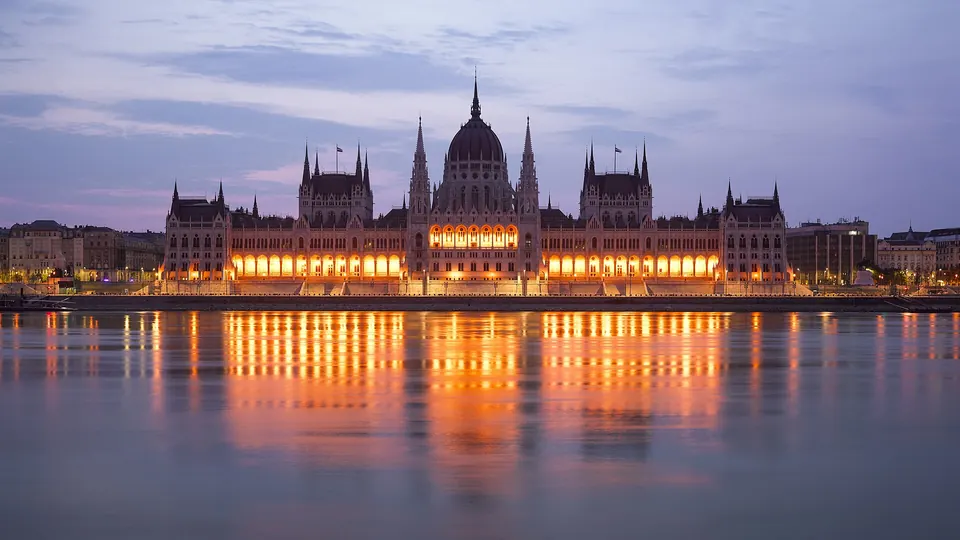
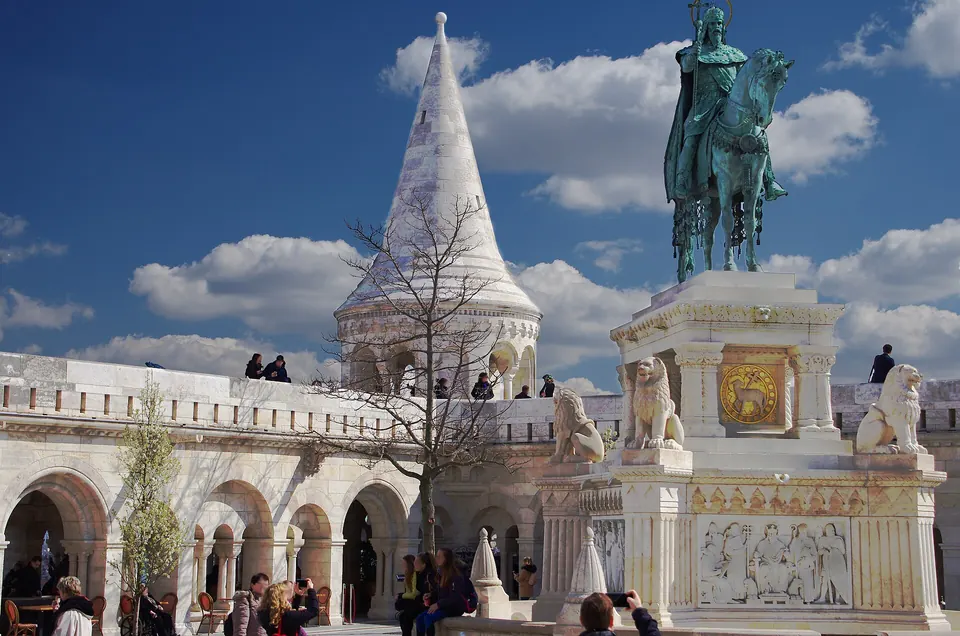
Budapest holds a good share of what there is to see in Hungary. UNESCO has listed three areas here: the Danube banks with their bridges, the Parliament and the Gresham Palace; the Buda Castle District, with Matthias Church, the Fisherman's Bastion and the Hungarian National Gallery; and Andrássy Avenue, which leads to the Opera House and the Franz Liszt Academy of Music. Allow three days to see these districts without rushing and to spend half a day in a thermal bath.
The Parliament: book ahead and bring ID
The Parliament interior can only be visited on a guided group tour at a set time. Tickets are sold in advance online (jegymester.hu); a small number go on sale the same day at the Kossuth tér visitor center. European Economic Area residents pay half what other visitors pay: the official 2025 price list showed 6,500 HUF versus 13,000 HUF for an adult, and several sources give 7,000 HUF versus 14,000 HUF for 2026. The EEA rate is checked at the entrance. As a US visitor you pay the higher rate, but carry your passport anyway.
The thermal baths
Széchenyi, in City Park, is the best-known bath in the city. Its ticket costs more on weekends than on weekdays, and the price depends on whether you take a locker or a cabin: check the day's price on the official website before you go. The less crowded Szent Lukács bath is included in the Budapest Card (see below).
Getting around and saving money in Budapest
According to the fares published by the BKK transport authority, a single ticket costs 500 HUF, the 24-hour pass 2,750 HUF and the 72-hour pass 5,750 HUF. The 100E airport bus requires a special ticket (2,500 HUF), payable by card on board. Tickets can also be bought in the BudapestGO app.
The 72-hour Budapest Card (29,990 HUF) adds to public transport entry to the Szent Lukács bath, a Danube cruise, the Zugliget chairlift and free entry to more than 30 museums and sites, including the permanent collections of the Museum of Fine Arts and the National Gallery. It also gives 10 to 25% off at St. Stephen's Basilica and the Dohány Street Synagogue.
The Danube Bend: Szentendre, Visegrád and Esztergom
North of Budapest, the Danube makes a bend between the hills: this is the Danube Bend. The easiest stop is Szentendre, about 40 minutes from Batthyány tér on the HÉV H5 suburban train, with departures every 10 to 20 minutes on weekdays. The town takes half a day: lanes, Orthodox churches and art museums.
Farther along, Visegrád and its citadel overlook the river, followed by Esztergom, on the Slovak border, with its basilica. These two stops each call for a full day. By car you can link all three towns; by public transport, it is better to pick one or two.
Lake Balaton and Hévíz: what to do in western Hungary
Lake Balaton, the largest lake in Central Europe, lies about 50 miles (80 km) southwest of Budapest. It is shallow (36 feet, or 11 m, at most according to Encyclopædia Britannica), which explains its popularity for summer swimming. On the north shore, the Tihany peninsula has an abbey whose origins go back to around the year 1100. At the western end, Keszthely has the Festetics Palace, one of the largest Baroque palaces in the country.
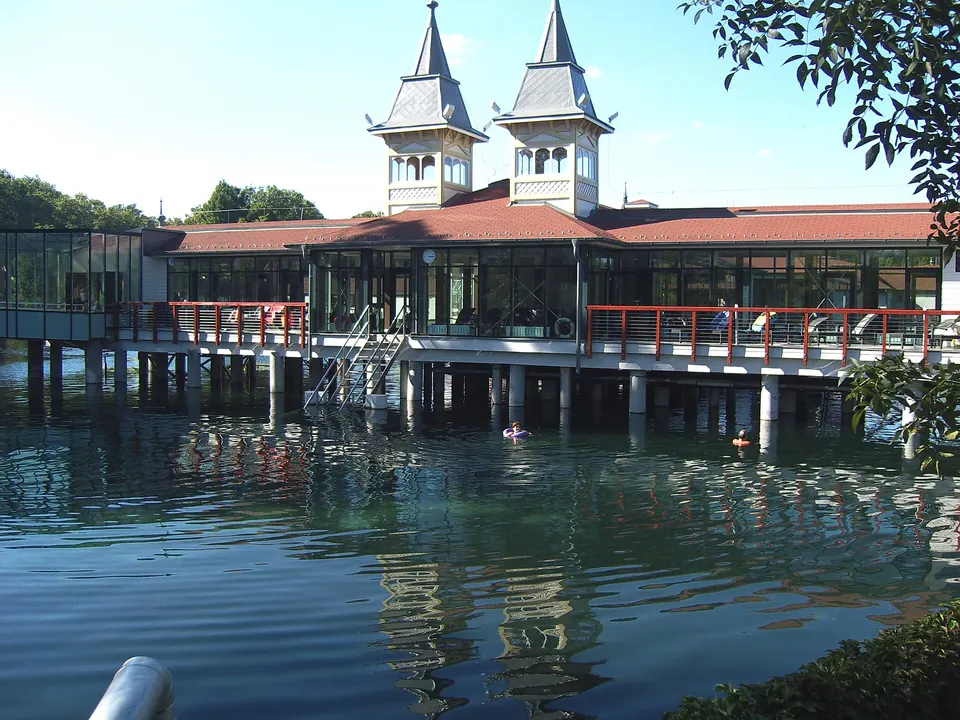
Just 4 miles (6 km) from Balaton, the thermal lake of Hévíz is the best reason to come off-season. According to the national tourist office Visit Hungary, this lake of 4.4 hectares (about 11 acres) and 125 feet (38 m) deep keeps its water at about 72–73°F (22–23°C) in winter and 97–100°F (36–38°C) in summer, and you can swim there all year. The office advises against staying in the water for more than 30 minutes at a stretch.
Eger, Tokaj and Hortobágy: wine and puszta in the northeast
Eger
Eger is the easiest excursion from Budapest: direct trains leave from Keleti station and arrive in under two hours, with no change. The town suits an overnight stay: Baroque center, castle, then wine cellars at the end of the day. If you are driving, Hollókő is easy to add along the way.
Tokaj
The Tokaj wine region has been a World Heritage site since 2002. Visit Hungary lists about 3,000 cellars spread over eight villages, including Tokaj and Mád. A direct train links Budapest-Keleti to Tokaj in about 2 h 45, but departures are infrequent: book accommodation locally rather than making a day trip.
Hortobágy
The country's first national park, listed by UNESCO in 1999, Hortobágy protects the puszta, the great Hungarian steppe where traditional herding has been practiced for more than 2,000 years. The sights: the Nine-Arch Bridge, the visitor center and the wildlife park. Spring and fall are the best seasons for watching nesting and migrating birds.
What else to see in Hungary: off-the-beaten-path UNESCO sites
- Pécs: in the south, the former Roman Sopianae preserves burial chambers from the 4th century, grouped in the Cella Septichora visitor center near the cathedral. Allow about 2 h 30 by train from Budapest.
- Pannonhalma Abbey: a Benedictine abbey founded in 996 and still active, with an arboretum, medicinal herb garden, cloister and museum. It combines well with Győr in the west of the country.
- Hollókő: a village of 55 traditional houses and a church, below the ruins of a medieval castle, in Nógrád County, about 62 miles (100 km) from Budapest.
- Aggtelek caves: about 1,200 caves on both sides of the Slovak border, including the 16-mile (26 km) Baradla-Domica system. It is 147 miles (236 km) from Budapest.
- Lake Fertő: a landscape of vineyards and reed beds shared with Austria, to explore on foot or by bike.
The full list and descriptions of these sites are on Visit Hungary's UNESCO page.
How many days to visit Hungary
The length of your trip depends mostly on how many regions you want to see besides Budapest. The table below offers four formats. The stops are doable by train, except Hollókő and the full Danube Bend, which are more practical by car.
| Length | Suggested plan | Best for |
|---|---|---|
| 3 days | Budapest: Buda Castle, Parliament, Andrássy Avenue, one thermal bath | Long weekend |
| 5 days | Budapest (3 days) + Szentendre (½ day) + Eger (1 night) | First trip, no car |
| 7 days | Budapest (3 days) + Danube Bend (1 day) + your choice: Balaton and Hévíz (3 days) or Eger and Tokaj (3 days) | A week's vacation |
| 10 days | Budapest (3 days) + Danube Bend (1 day) + Eger, Tokaj and Hortobágy (3 days) + Balaton and Hévíz or Pécs (3 days) | A tour of the country, ideally with a car |
With a week, choose between the west (lake, baths, abbeys) and the northeast (wine, puszta, caves) rather than trying to do everything: the two regions lie on opposite sides of Budapest, and linking them almost always means going back through the capital.
Planning your trip to Hungary: entry rules, money and transport
Entry rules for US travelers
Hungary is in the Schengen Area. US citizens can stay up to 90 days in any 180-day period without a visa, and you need a valid passport. Check the official ETIAS page and the US State Department's Hungary travel page for the current entry requirements before you book. Flights to Budapest from the US usually connect through a European hub; check airlines from your home airport for current options. Hungary uses Type C/F plugs, so bring an adapter, and check your carrier's international plan before using data abroad.
Money
Hungary is not in the eurozone: the currency is the forint (HUF). Think in forints for transport tickets, entrance fees and baths, whose prices are posted in that currency.
By car
Driving is on the right, as at home. Motorways and some main roads require an electronic vignette (e-matrica), sold online, at gas stations at motorway entrances and at the borders; keep the receipt, which serves as proof. In 2026, the 10-day vignette for a car costs a little under 7,000 HUF. Ask your rental company about license requirements for US drivers. Authorities report secondary roads of average quality, with potholes, and level crossings that are sometimes poorly signed.
By train
The train is the simplest way to link Budapest with Eger, Tokaj or Pécs. Timetables and tickets are on the MÁV website. For villages like Hollókő, or to link the towns of the Danube Bend, a rental car saves a lot of time.
In an emergency, dial 112.
Frequently asked questions
What should I see first in Hungary?
How many days do you need in Hungary?
Do Americans need a visa for Hungary?
Can you pay in euros in Hungary?
Can you visit Hungary without a car?
Sources
- Hongrie – Conseils aux voyageurs : entrée et séjour (diplomatie.gouv.fr)
- Hongrie – Conseils aux voyageurs : informations utiles (diplomatie.gouv.fr)
- Présentation de la Hongrie (diplomatie.gouv.fr)
- BKK – Ticket and pass prices
- BKK – Budapest Card for 72 hours (valid from 1 May 2026)
- Visit Hungary – UNESCO World Heritage Sites in Hungary
- Visit Hungary – Take a dip in Lake Hévíz
- Visit Eger – Approaching Eger by train
- Hungarian Parliament – Ticket prices
- Hungarian Parliament Building tickets & tours (Ticketlens)
- Britannica – Lake Balaton
- Rome2rio – Budapest to Tokaj
- Rome2rio – Budapest to Pécs
- Budapest by Locals – Szentendre day trip
- Travel Information Europe – Hungary toll roads
- Budapest thermal baths prices and tickets 2026
- UNESCO – World Heritage List: Hungary
Facts checked against these sources on November 9, 2026.