Which Swiss City Should You Visit? Best Cities by Trip Type, and How to Link Them
Photo : NOTE: This image is a panorama consisting of multiple frames that were merged or stitched in software. As a result, thi · CC BY-SA 4.0 · Wikimedia Commons
For a first trip, pick Bern for its UNESCO-listed old town and Lucerne for its wooden covered bridge facing the mountains. Add Geneva or Lausanne if you are coming from France on the TGV Lyria. Basel suits museum lovers, Lugano suits anyone after an Italian feel, and St Gallen or La Chaux-de-Fonds suit travellers who want to leave the busiest routes. A dense rail network links the cities, so you can string together three or four in a week without a car.
The question "which city should I visit in Switzerland?" has no single answer. It depends on how many days you have, where you arrive, and what you want (medieval heritage, museums, lakes, an Italian atmosphere). This guide ranks the best Swiss cities by trip type, with the travel times you need to combine them. For an overview of the country (regions, mountains, seasons), see our complete guide to planning a trip to Switzerland.
Which Swiss City Should You Visit on a First Trip?
Bern: the federal capital and its UNESCO old town
Bern is the most complete choice for getting to know a Swiss city. Its medieval centre has been a UNESCO World Heritage Site since 1983. You walk beneath about 6 km of covered arcades, the Lauben, described as one of the longest covered shopping promenades in Europe. The Zytglogge clock tower, with its 16th-century astronomical clock, marks the central axis of the old town. The Federal Palace, seat of the government and Parliament, is a few streets away.
Allow a full day for the old town, the banks of the Aare and the Federal Palace. Bern also sits on the direct Geneva–Zurich line, which makes it a good base for day trips.
Lucerne: a lakeside city at the foot of the mountains
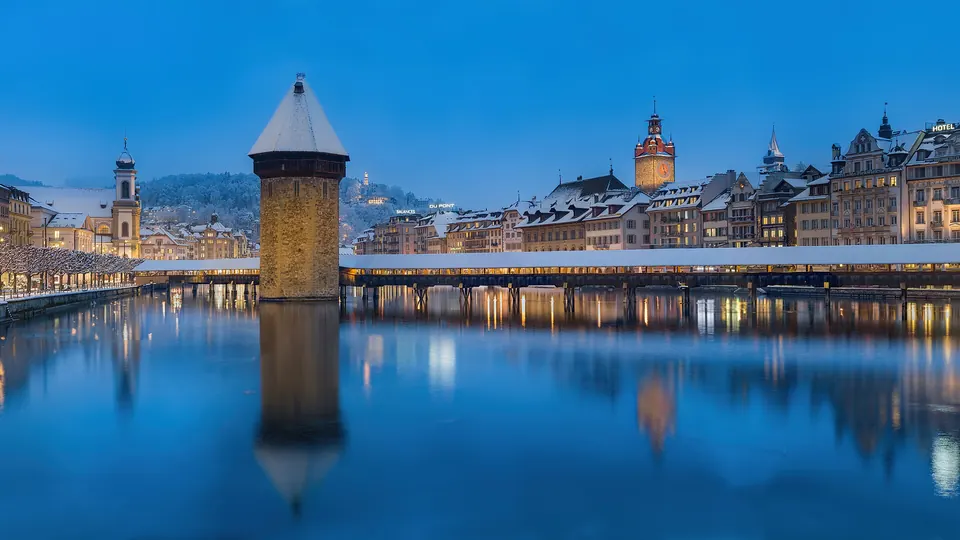
Lucerne is the city to choose if you want both an old town and mountain excursions. Its emblem, the Kapellbrücke (Chapel Bridge), crosses the Reuss at a diagonal. Built in the 14th century, it is the oldest covered wooden bridge in Europe. It almost entirely burned down on 18 August 1993: the fire destroyed two thirds of the interior paintings, and the bridge was then restored and reopened in 1994.
Lucerne is about 41 minutes from Zurich on the fastest trains, and a little over an hour from Bern. Mount Rigi, whose cog railway is included in the Swiss Travel Pass, can be reached from the city by lake boat.
Which Swiss City to Visit When Arriving From France?
From Paris, TGV Lyria trains run directly to four Swiss cities, according to Switzerland Tourism:
| Direct route | Approximate time | Frequency |
|---|---|---|
| Paris – Basel | 3h 04 | up to 6 a day |
| Paris – Geneva | 3h 11 | up to 8 a day |
| Paris – Lausanne | 3h 41 | up to 6 a day |
| Paris – Zurich | 4h 04 | up to 6 a day |
| Marseille – Geneva | 3h 43 | 1 a day, July and August only |
For a weekend from Paris, Basel and Geneva are therefore the easiest Swiss cities to visit. For a longer stay, arrive in Geneva and leave from Zurich (or the reverse): the direct IC1 train links the two cities every hour in a little under 3 hours, via Bern.
Geneva: the lake and international Geneva
Geneva is best explored along Lake Geneva. Its landmark is the Jet d'Eau, which shoots 500 litres of water per second up to 140 metres, according to the Geneva tourist office. The city suits a two-day stay: the old town on the hill, the lake quays and the district of the international organisations.
Lausanne, Lavaux and Montreux: the Vaud Riviera
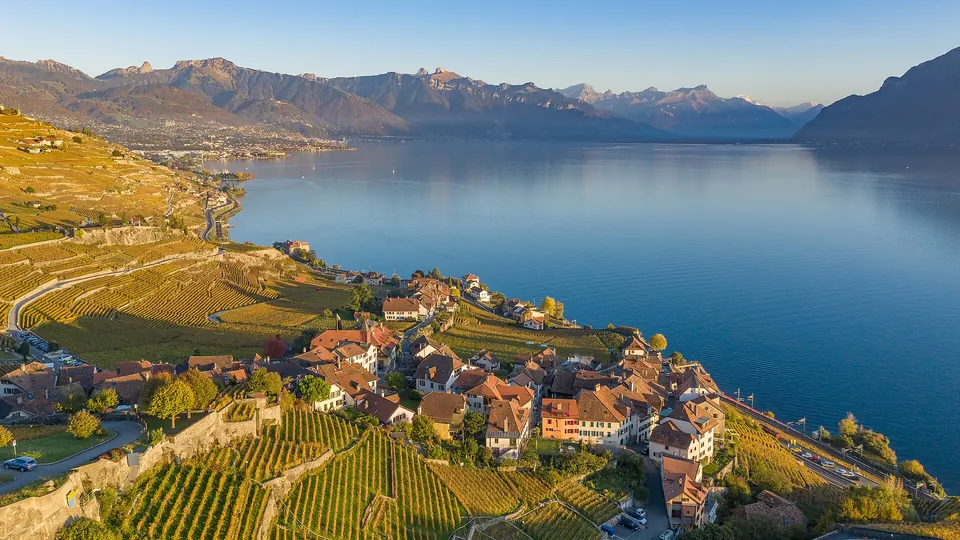
Lausanne pairs well with its immediate surroundings. On the lakefront at Ouchy, the Olympic Museum opened in 1993 in the city that hosts the International Olympic Committee. To the east begin the terraced vineyards of Lavaux, a UNESCO site since 2007: about 800 hectares, the largest continuous vineyard in Switzerland. A trail of about 32 km (20 miles) links the Olympic Museum at Ouchy to Chillon Castle, near Montreux. You can walk just part of it and return by train or boat.
Which Swiss Cities to Visit Based on Your Interests?
Basel for museums
Basel has nearly 40 museums in only 37 km², according to the canton of Basel-Stadt. It is the Swiss city to visit if art is your priority. Its position on the French and German borders and its direct link with Paris make it a good choice for a short cultural break. The list of museums and current exhibitions is on the Basel Tourism website.
Zurich for the liveliest city
Zurich is often the entry point for long-haul flights. It has an old town on both banks of the Limmat, Lake Zurich and a dense choice of restaurants and nightlife. One day is enough for the historic centre. Zurich is also a starting point for Lucerne, 41 minutes away, or for Lugano.
Lugano for an Italian atmosphere
Lugano, on its lake in the Italian-speaking canton of Ticino, shows another face of Switzerland: Italian architecture, food and language. The fastest direct trains connect it to Zurich in under two hours. It is the city to add to an itinerary that passes through the centre of the country.
St Gallen for the abbey library
In the east of the country, the St Gallen abbey precinct (cathedral, library and conventual buildings) has been a UNESCO World Heritage Site since 1983. The library's Baroque hall is the main draw. The library is also listed twice in UNESCO's Memory of the World Register: in 2009 for the Nibelungen manuscript and in 2017 for its historical collection. Opening hours and tickets are on the official Stiftsbezirk website.
La Chaux-de-Fonds and Le Locle for watchmaking
These two towns in the Neuchâtel Jura have been listed together as a World Heritage Site since 2009 under the title "watchmaking town planning". They are described as the only examples in the world of urban centres built for and by the watchmaking industry. Their grid plan was designed around the watchmakers' workshops (UNESCO listing). The stop suits travellers who have already seen the big cities or who arrive via the Jura.
Summary Table: Which Swiss City Should You Choose?
| City | Best for | Suggested time | Highlight |
|---|---|---|---|
| Bern | First trip, heritage | 1 day | UNESCO old town, 6 km of arcades |
| Lucerne | Lake and mountains | 2 days with an excursion | Kapellbrücke, Rigi |
| Geneva | Arriving from France, the lake | 1 to 2 days | Jet d'Eau, Lake Geneva quays |
| Lausanne and Lavaux | Vineyards, easy walking | 1 to 2 days | UNESCO terraces, Olympic Museum |
| Basel | Art and museums | 1 to 2 days | Nearly 40 museums |
| Zurich | Lively city, arriving by plane | 1 day | Old town, lake |
| Lugano | Italian atmosphere | 1 to 2 days | Lake, Ticino |
| St Gallen | Heritage off the busiest routes | Half a day to 1 day | Abbey library |
| La Chaux-de-Fonds / Le Locle | Watchmaking, urban planning | Half a day to 1 day | UNESCO watchmaking town planning |
The durations are approximate: they cover a visit to the centre and main sights, without long excursions.
How Many Swiss Cities Can You Visit in One Week?
In seven days, three or four cities make a reasonable pace, since the Geneva–Bern–Zurich axis is served every hour. Here is a sample itinerary from west to east, which you can reverse if you arrive in Zurich:
| Day | Stop | What to do |
|---|---|---|
| 1–2 | Geneva | Old town, quays, Jet d'Eau |
| 3 | Lausanne and Lavaux | Ouchy, one section of the Lavaux trail, return by train |
| 4 | Bern | Old town, arcades, Zytglogge, Federal Palace |
| 5–6 | Lucerne | Kapellbrücke, old town, excursion to Rigi |
| 7 | Zurich | Old town and lake before departure |
With one more day, add Lugano from Lucerne or Zurich. If your departing train leaves from Basel, make Basel your last stop instead of Zurich.
Getting Between Swiss Cities: Swiss Travel Pass or Point-to-Point Tickets?
For a multi-city trip, the Swiss Travel Pass is the simplest option. It gives unlimited travel on trains, buses and boats, public transport in more than 90 cities, and entry to more than 500 museums. It also includes the Rigi, Stanserhorn and Stoos lifts and railways, and gives up to 50% off other mountain trains. Scenic trains such as the Glacier Express or the Bernina Express require a reservation or a supplement. 2026 prices in 2nd class for one adult:
| Duration (consecutive days) | 2nd class price |
|---|---|
| 3 days | 254 CHF |
| 4 days | 309 CHF |
| 6 days | 399 CHF |
| 8 days | 439 CHF |
| 15 days | 499 CHF |
The Flex version (3 days to use within one month) costs 289 CHF in 2nd class. Children from age 6 up to the day before their 16th birthday travel free with at least one parent thanks to the Swiss Family Card, added free at booking. Children under 6 travel free with a person holding a valid ticket. If you are staying in one area for a long time, the Swiss Half Fare Card, at 150 CHF for one month in 2026, halves the price of tickets.
What to Know Before You Go
- Entry for UK passport holders: Switzerland is in the Schengen area. UK visitors can stay up to 90 days in any 180-day period. Your passport must have been issued less than 10 years before the day you enter and be valid for at least 3 months after you leave. For the latest on entry checks, the EES and ETIAS, see the GOV.UK travel advice for Switzerland.
- Money and phone: Switzerland uses the Swiss franc (CHF). Payment in euros and by card is generally accepted, but change is given in Swiss francs. Switzerland is not in the EU, so check your UK provider's roaming charges before you travel.
- Plugs: bring a plug adapter for your UK devices.
- By car: the motorway vignette costs 40 CHF. It can be bought at border crossings, at post offices or before departure in the euro zone. Headlights must stay on day and night, and speed limits are 120 km/h (75 mph) on motorways, 80 km/h (50 mph) on country roads and 50 km/h (31 mph) in built-up areas. You drive on the right, unlike at home. For a tour between cities, though, the train saves you from hunting for parking in city centres.
Frequently asked questions
What is the most beautiful city to visit in Switzerland?
Which Swiss city is best for a weekend from Paris?
Do UK citizens need a visa to visit Switzerland?
Is the Swiss Travel Pass worth it for visiting several cities?
How many cities can you visit in Switzerland in one week?
Sources
- Swiss Travel Pass – Suisse Tourisme (MySwitzerland)
- Swiss Travel Pass Flex – Suisse Tourisme (MySwitzerland)
- By train from France – MySwitzerland
- Suisse – Conseils aux voyageurs, Entrée/Séjour – France Diplomatie
- Suisse – Conseils aux voyageurs, Informations utiles – France Diplomatie
- Le Jet d'eau – Genève Tourisme
- Musées à Bâle – Bâle Tourisme
- Capitale culturelle de la Suisse – Canton de Bâle-Ville
- Stiftsbibliothek St. Gallen – Stiftsbezirk
- La Chaux-de-Fonds / Le Locle, urbanisme horloger – UNESCO
- Lavaux vineyard terraces – MySwitzerland
- UNESCO-listed Lavaux vineyard terraces – Lausanne Tourisme
- Visitor Card Lucerne – Lucerne Tourisme
- Kapellbrücke – Wikipedia
- Bern Old Town – Switzerlanding
- Zurich to Geneva by train – EveryRail
- Zurich to Lucerne train – Rail Europe
- Trains Zurich – Lugano – Virail
- Price adjustments in Swiss public transport from 2026 – Travel Switzerland
Facts checked against these sources on 3 November 2026.